October 13, 2020 NHTSA CAMPAIGN NUMBER: 20V630000
Lithium-Ion Battery May Short Circuit
An electrical short in the Li-ion battery increases the risk of a fire.
NHTSA Campaign Number: 20V630
Manufacturer Hyundai Motor America
Components ELECTRICAL SYSTEM
Potential Number of Units Affected 6,707
Summary
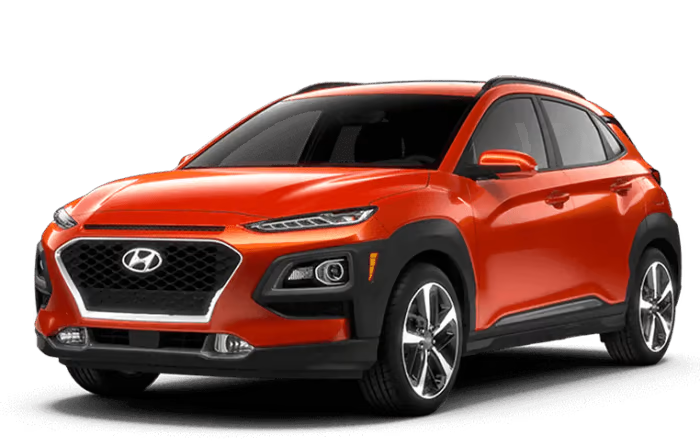
Hyundai Motor America (Hyundai) is recalling certain 2019-2020 Kona Electric vehicles. The lithium-ion (Li-ion) battery may short-circuit after it is fully charged.
Remedy
Hyundai will notify owners, and dealers will update the Battery Management System (BMS) software and inspect the Li-ion battery, replacing it if necessary, free of charge. Owners are advised to park their vehicles outside and away from structures until the repair is complete. The recall began November 13, 2020. Owners may contact Hyundai customer service at 1-855-371-9460. Hyundai’s number for this recall is 196.
Notes
Owners may also contact the National Highway Traffic Safety Administration Vehicle Safety Hotline at 1-888-327-4236 (TTY 1-800-424-9153), or go to www.safercar.gov.
Check if your Hyundai has a Recall
| Technical Service Bulletin | GROUP
RECALL | NUMBER
21-01-006H |
| DATE
FEBRUARY, 2021 | MODEL(S)
Kona Electric (OS EV) | |
| SUBJECT:
HIGH VOLTAGE BATTERY SOFTWARE UPDATE, INSPECTION AND REPLACEMENT DTC P1AA600 (RECALL CAMPAIGN 196) | ||
This TSB supersedes TSB# 20-01-042H to revise the Service Procedure, add HV battery replacement and update the Warranty section with additional OP codes.
IMPORTANT
Dealers must perform this Recall Campaign on all affected vehicles prior to customer retail delivery and whenever an affected vehicle is in the shop for any maintenance or repair.
When a vehicle arrives at the Service Department, access Hyundai Motor America’s “Vehicle Information Screen (VIS)” screen via WEBDCS to identify open Campaigns.
Description: The battery system in certain 2019-2020MY Kona Electric vehicles may be faulty and/or contain software that may need to be updated. These conditions may increase the risk of an electrical short circuit. Follow the procedure to update the specified ECU modules. An inspection is required after the software updates are completed to determine if additional repairs are necessary.
Applicable Vehicles: Certain 2019-2020MY Kona Electric (OS EV)
Part Information:
If high voltage (HV) battery replacement is necessary according to the Service Procedure, refer to TSB 20-EE-001H-2 (or latest revision) for replacement procedures, ordering instructions, and approval guidelines.
Warranty Information:
| Model | Op. Code | Operation | Op. Time | Causal Part | Nature | Cause |
| Kona Electric (OS EV) | 01D076RA | BMS & VCULDC UPDATE | 0.5 M/H | 37501-K4000QQH | I11 | ZZ3 |
| 01D076RB | IGPM, MCU, BMS & VCULDC UPDATE | 1.1 M/H | 37501-K4000QQH | I11 | ZZ3 | |
| 01D076RC | HV BATTERY REPLACEMENT | 3.4 M/H | 37501-K4000QQH | I11 | ZZ3 | |
| 01D076RD | HV BATTERY REPLACEMENT & BMS UPDATE | 3.7 M/H | 37501-K4000QQH | I11 | ZZ3 |
NOTE 1: Submit Claim on Campaign Claim Entry Screen.
NOTE 2: If a part is found in need of replacement while performing this Recall Campaign and the affected part is still under warranty, submit a separate warranty claim using the same Repair Order. If the affected part is out of warranty, submit a Prior Approval Request for goodwill consideration prior to performing the work.
Service Procedure:
- Scan for DTCs in the BMS System using the GDS.
NOTICE
Ensure all Freeze Frame Data and Information Codes are collected if any DTCs are detected in the BMS System.
If DTCs are detected in the BMS System, collect all related Freeze Frame Data and all Information Codes for the DTC.
- For DTC P1AA600:
-
- Replace the high voltage battery according to procedures in TSB 20-EE-001H-2 (or latest revision).
-
- When repairs are completed and there are no DTCs, continue to Step 2.
- For other DTC, follow the related shop manual to repair the vehicle then continue to Step 2.
If no DTCs are detected in the BMS System:
Proceed to Step 2.
- If there are no DTCs in the BMS System, update the ECU software using the GDS for the following systems. Reference the GDS Information section for Event #.
NOTICE
Do not proceed with ECM updates before diagnosing and repairing all DTCs in the BMS System.
Note: Check Campaign 960 completion status on VIS. If Campaign 960 was completed, a software update for (c) and (d) is not required since these systems were previously updated during Campaign 960.
NOTICE
Perform all ECM updates in AUTO mode first. If AUTO mode is not successful then MANUAL mode can be used.
a) BMS (Battery Management System)
b) VCULDC (Vehicle Control Unit & Low DC-DC Converter)
c) IGPM (Integrated Gateway Power Module)
d) MCU (Motor Control Unit)
Refer to TSB 15-GI-001 for the general GDS Mobile ECU update procedures.
! WARNING
THE 12V BATTERY VOLTAGE CHECK IS CRITICAL FOR THIS MULTI-ECU UPDATE AS IT COULD DRAW DOWN THE 12V BATTERY WHILE THE IGNITION IS ON.
STOCK VEHICLES ARE PRONE TO LOW BATTTERY CONDITION. OPERATE A STOCK VEHICLE AT READY ON FOR 20 MINUTES PRIOR TO STARTING THE MULTI-ECU UPDATE.
THIS WILL ENSURE 12V BATTERY WILL BE CHARGED TO AN ADEQUATE LEVEL, PREVENTING POTENTIAL UPDATE FAILURE OR CONTROLLER DAMAGE.
! WARNING
If a low battery warning message appears on the GDS, operate the vehicle in Ready mode for at least 20 minutes to ensure the 12 V battery is adequately charged before performing any software updates.
- After successful completion of the applicable system updates, search all systems for DTCs.
If no DTC are found, the procedure is complete.
NOTICE
Refer to TSB 20-EE-001H-2 for high voltage (HV) battery approval guidelines.
DTC, Freeze Frame Data (FFD), current BMS data screens, and other information must be submitted according to the procedures in TSB 20-EE-001H-2 (or latest revision).
If DTCs are detected in the BMS System, collect all related Freeze Frame Data and all Information Codes for the DTC.
- For DTC P1AA600:
-
- Replace the high voltage battery according to procedures in TSB 20-EE-001H-2 (or latest revision).
-
- When repairs are completed and there are no DTCs, follow Step 2 to update the BMS software, if applicable.
- For other DTC, follow the related shop manual to repair the vehicle.
GDS Information:
NOTICE
All ECM updates should be performed in Auto Mode first. If the ECM update starts but then fails in Auto Mode, perform these updates in Manual Mode.
| Event # | Description |
| 655*
656*
| OS EV – IMPROVED MONITORING LOGIC APPLICATION(BMS)
OS EV – IMPROVED MONITORING LOGIC APPLICATION(BMS,ROM duplication) Note: 1) Select Event #655 first. 2) If an error message is displayed or the update is not successful, try Event #656. 3) Try an event after #655/656 if one is available. |
| 657* | OS EV – HIGH VOLTAGE BATTERY MONITORING LOGIC APPLICATION(VCULDC) |
| 590* | OS EV – HIGH VOLTAGE BATTERY MONITORING LOGIC APPLICATION(MCU) Note: Not required if Campaign 960 is completed. |
| 592* | OS EV – HIGH VOLTAGE BATTERY MONITORING LOGIC APPLICATION(IGPM) Note: Not required if Campaign 960 is completed. |
(*or later event if one is shown for each system)
ROM ID INFORMATION TABLE:
1) BMS (#655)
The BMS ROM ID can be found on the LH side of the high voltage battery underneath the vehicle. Cross-reference the ROM ID in the column labeled “OLD” in the table to find the applicable BMS P/No. and NEW ROM ID.
| VEHICLE | SYSTEM | BMS P/NO | ROM ID | |
| OLD | NEW | |||
| OSEV | BMS | 375A0-K4050 | 5300 | 6100 |
| 5400 | ||||
| 5500 | ||||
| 5700 | ||||
| 5800 | ||||
| 5900 | ||||
| 6000 | ||||
| 6020 | ||||
| 6040 | ||||
| 6050 | ||||
| 6060 | ||||
| 6070 | ||||
| 6080 | ||||
| 6090 | ||||
| OSEV | BMS | 375A0-K4000 | 5302 | 6102 |
| 5402 | ||||
| 5502 | ||||
| 5702 | ||||
| 5802 | ||||
| 5902 | ||||
| 6002 | ||||
| 6022 | ||||
| 6042 | ||||
| 6052 | ||||
| 6062 | ||||
| 6072 | ||||
| 6082 | ||||
| 6092 | ||||
| OSEV | BMS | 375A0-K4450 | 5304 | 6104 |
| 5404 | ||||
| 5504 | ||||
| 5704 | ||||
| 5804 | ||||
| 5904 | ||||
| 6004 | ||||
| 6024 | ||||
| 6044 | ||||
| 6054 | ||||
| 6064 | ||||
| 6074 | ||||
| 6084 | ||||
| 6094 | ||||
| OSEV | BMS | 375A0-K4400 | 5306 | 6106 |
| 5406 | ||||
| 5506 | ||||
| 5706 | ||||
| 5806 | ||||
| 5906 | ||||
| 6006 | ||||
| 6026 | ||||
| 6046 | ||||
| 6056 | ||||
| 6066 | ||||
| 6076 | ||||
| 6086 | ||||
| 6096 | ||||
| OSEV | BMS | 375A0-K4051 | 6200 | 6600 |
| 6220 | ||||
| 6240 | ||||
| 6540 | ||||
| 6550 | ||||
| 6560 | ||||
| 6570 | ||||
| 6580 | ||||
| 6590 | ||||
| OSEV | BMS | 375A0-K4001 | 6202 | 6602 |
| 6222 | ||||
| 6242 | ||||
| 6542 | ||||
| 6552 | ||||
| 6562 | ||||
| 6572 | ||||
| 6582 | ||||
| 6592 | ||||
| OSEV | BMS | 375A0-K4451 | 6204 | 6604 |
| 6224 | ||||
| 6244 | ||||
| 6524 | ||||
| 6544 | ||||
| 6554 | ||||
| 6564 | ||||
| 6574 | ||||
| 6584 | ||||
| 6594 | ||||
| OSEV | BMS | 375A0-K4401 | 6206 | 6606 |
| 6226 | ||||
| 6246 | ||||
| 6526 | ||||
| 6546 | ||||
| 6556 | ||||
| 6566 | ||||
| 6576 | ||||
| 6586 | ||||
| 6596 | ||||
| OSEV | BMS | 375A0-K4052 | 6400 | 6800 |
| 6500 | ||||
| 6700 | ||||
| 6730 | ||||
| 6740 | ||||
| 6770 | ||||
| 6780 | ||||
| 6790 | ||||
| OSEV | BMS | 375A0-K4002 | 6402 | 6802 |
| 6502 | ||||
| 6702 | ||||
| 6732 | ||||
| 6742 | ||||
| 6772 | ||||
| 6782 | ||||
| 6792 | ||||
| OSEV | BMS | 375A0-K4452 | 6504 | 6804 |
| 6734 | ||||
| 6744 | ||||
| 6774 | ||||
| 6784 | ||||
| 6794 | ||||
| OSEV | BMS | 375A0-K4402 | 6506 | 6806 |
| 6736 | ||||
| 6746 | ||||
| 6776 | ||||
| 6786 | ||||
| 6796 | ||||
2) BMS (#656)
The BMS ROM ID can be found on the LH side of the high voltage battery underneath the vehicle. Cross-reference the ROM ID in the column labeled “OLD” in the table to find the applicable BMS P/No. and NEW ROM ID
| VEHICLE | SYSTEM | BMS P/NO | ROM ID | |
| OLD | NEW | |||
| OSEV | BMS | 375A0-K4052 | 6400 | 6900 |
| 6500 | ||||
| 6700 | ||||
| 6730 | ||||
| 6740 | ||||
| 6770 | ||||
| 6780 | ||||
| 6790 | ||||
| OSEV | BMS | 375A0-K4002 | 6402 | 6902 |
| 6502 | ||||
| 6702 | ||||
| 6732 | ||||
| 6742 | ||||
| 6772 | ||||
| 6782 | ||||
| 6792 | ||||
| OSEV | BMS | 375A0-K4452 | 6504 | 6904 |
| 6734 | ||||
| 6744 | ||||
| 6774 | ||||
| 6784 | ||||
| 6794 | ||||
| OSEV | BMS | 375A0-K4402 | 6506 | 6906 |
| 6736 | ||||
| 6746 | ||||
| 6776 | ||||
| 6786 | ||||
| 6796 | ||||
2) VCULDC(#657)
| VEHICLE | SYSTEM | VCULDC P/NO. | ROM ID | |
| OLD | NEW | |||
| OS EV | VCULDC | 36601-0E170 | EOSEJNM-NS0-D000
EOSEJNM-NS1-D000 EOSEJNM-NS2-D000 EOSEKNM-NS3-D000 EOSEKNM-NS4-D000 EOSEKNM-NS5-D000 EOSEKNM-NS6-D000 EOSEKNM-NS7-D000 | EOSEKNM-NS8-D000 |
3) MCU (#590)
| VEHICLE | SYSTEM | MCU P/NO. | ROM ID | |
| OLD | NEW | |||
| OS EV | MCU | 36601-0E170 | EOSEJDL-MS0-D000
EOSEJDL-MS1-D000 EOSEKNLMS1-D000 | EOSEKNLMS2-D000 |
4) IGPM (#592)
| VEHICLE | SYSTEM | IGPM P/NO. | ROM ID | |
| OLD | NEW | |||
| OS EV | IGPM | 91950-K4010
91950-K4020 91950-K4030 91950-K4040 91950-K4050 91950-K4060 91950-K4070 91950-K4080 91950-K4090 91950-K4100 91950-K4110 91950-K4120 91950-K4130 91950-K4140 91950-K4011 91950-K4021 91950-K4031 91950-K4041 91950-K4051 91950-K4061 91950-K4071 91950-K4081 91950-K4091 91950-K4101 91950-K4111 91950-K4121 91950-K4131 91950-K4141 | K401
K402 K403 K404 K405 | K406 |
| K601
K602 | K603 | |||
MANUAL MODE PASSWORD INFORMATION TABLE:
#655 (BMS)
| MENU | P/W |
| OS EV BMS 375A0-K4050 | 4051 |
| OS EV BMS 375A0-K4000 | 4001 |
| OS EV BMS 375A0-K4450 | 4451 |
| OS EV BMS 375A0-K4400 | 4401 |
| OS EV BMS 375A0-K4051 | 4052 |
| OS EV BMS 375A0-K4001 | 4002 |
| OS EV BMS 375A0-K4451 | 4452 |
| OS EV BMS 375A0-K4401 | 4402 |
| OS EV BMS 375A0-K4052 | 4053 |
| OS EV BMS 375A0-K4002 | 4003 |
| OS EV BMS 375A0-K4452 | 4453 |
| OS EV BMS 375A0-K4402 | 4403 |
#656 (BMS)
| MENU | P/W |
| OS EV BMS 375A0-K4052 | 0405 |
| OS EV BMS 375A0-K4002 | 0400 |
| OS EV BMS 375A0-K4452 | 0445 |
| OS EV BMS 375A0-K4402 | 0440 |
#657 (VCULDC)
| MENU | P/W |
| OS EV VCULDC36601-0E170 | 0170 |
#590 (MCU)
| MENU | P/W |
| OS EV MCU 36601-0E170 | 0170 |
#592 (IGPM)
| MENU | P/W |
| OS EV IGPM 91950-K4010~K140, K4011~K141(ROM ID : K401/2/3/4/5) | 3000 |
| OS EV IGPM 91950-K4010~K140, K4011~K141(ROM ID : K601/2) | 3001 |
Q&A
Q1: What is the issue?
A1: The high-voltage battery system in the subject vehicles might contain certain electrical deficiencies, such as internal damage to certain cells of the lithium-ion battery and/or faulty battery management system (“BMS”) control software that could increase the risk of an electrical short circuit after fully charging the Li-ion battery. Hyundai is continuing to actively investigate this condition for identification of a specific root cause.
Q2: What are the affected vehicles?
A2: The subject vehicles include model year 2019-2020 Hyundai Kona electric vehicles (“EV”) built between August 28, 2018 and March 2, 2020 by Hyundai Motor Company (“HMC”) for sale in the U.S. market. The affected population was determined based on suspect production lot information provided by the supplier and vehicle assembly records.
Q3: What is the safety concern?
A3: An electrical short in Li-ion battery could increase the risk of a fire.
Q4: Have there been any accidents or injuries?
A4: To date, Hyundai is not aware of any crashes or fires in the U.S. attributable to this condition. Hyundai is aware of at least nine fires in South Korea, two in Canada, and two in the European market.
Q5: What will be done during the recall service at the dealer?
A5: Customers are advised to park their vehicles outdoors and/or away from structures until their vehicle is remedied. Hyundai is planning to notify owners to bring their vehicles to the nearest Hyundai dealership for inspection and replacement of the Li-ion battery, if necessary. As an added level of protection, Hyundai is also planning on updating the BMS software to allow for detection of abnormalities in the high-voltage battery system while parked. This current TSB addresses the software update and inspection, including the repair process for those vehicles that have the DTC P1AA600 found during inspection. The remedy procedure will be performed at no charge. Hyundai will provide reimbursement to owners for repairs according to the plan submitted to NHTSA on May 16, 2018.
Q6: When will owners be notified?
A6: Owners will be mailed notification letters beginning in mid-December 2020.
SEOCONTENT-START
Recall 196 Dealer Best Practice
Date: February 05, 2021
Attn: Dealer Principal/General Manager/Service Manager/Parts Manager
Subject: Recall 196: Kona EV Battery System – Remedy Now Available (TSB# 21-01-006H supersedes TSB #20-01-042H-1) v4
Updates To This Document
Date
• Update – Revised TSB with updates to the Service Procedure, add HV battery replacement, and update the Warranty section with additional OP codes.
2/05/21
***IMPORTANT Dealer Stock and Retail Vehicles***
As required by federal law, dealers must not deliver new vehicles for sale or for lease to customers until all open recalls have been performed. Dealers should also perform all open recalls on used vehicles, demo and rental vehicles prior to placing them into customer use and whenever an affected vehicle is in the shop for any maintenance or repair.
Affected Vehicles
Hyundai is conducting a safety recall in the United States to address a condition with the high-voltage battery system in certain model year 2019-2020 Hyundai Kona Electric vehicles produced for sale in the U.S. market.
The affected vehicles include:
• Certain 2019-2020MY Kona Electric (OS EV)
Hyundai is initiating this action to ensure the safety and compliance of its vehicles and the continued satisfaction of Hyundai customers.
IMPORTANT NOTE: Service Campaign 960 has been terminated in accordance with Recall 196 having the most updated software for the affected vehicles.
Description
The battery system in certain 2019-2020MY Kona Electric vehicles may be faulty and/or contain software that may need to be updated. These conditions may increase the risk of an electrical short circuit. Follow the procedure to update the specified ECU modules. An inspection is required after the software updates are completed to determine if additional repairs are necessary.
Service Action
Reservation – Always check the Vehicle Information Screen in WebDCS for open campaigns and recalls, and advise the customer on time requirements.
• Important: If there are affected vehicles in Dealer’s stock inventory, vehicles must be held at the dealership and not sold until this recall repair has been completed. Dealer will forfeit incentives if vehicles with an open recall are sold to customers.
Readiness – Review this announcement and the accompanying FAQs with all Service and Parts staff including Reservationist/BDC. Also, complete all applicable training, check your reservation capacity settings (you can set separate capacities for every recall/campaign), confirm email addresses for campaign appointments, and that you have all necessary tools, campaign parts and shop equipment as needed.
• Recommended Level of Technician Certification and/or Completed Coursework to perform TSB work:
o Hyundai Master Technician with Hybrid Vehicle Training – Classroom (#SVCHHHYBVEHTRN218_800) and Electric Vehicle Battery R&I Training – Web ($SVCHEVHVBRWIW19_811) courses completed
• Eco-friendly vehicle owners should be provided an equivalent eco-friendly SRC, or alternative transportation, as needed.
• Please ensure to park these vehicles outdoors and/or away from structures until the vehicle is remedied.
Reception – Always check the Vehicle Information Screen in WebDCS for open campaigns and recalls, and print a copy for technicians. Provide SRC or an alternative vehicle, as needed. If a customer has declined the campaign, note this on the repair order and request the customer’s signature next to the statement.
• When a vehicle arrives at the Service Department, access Hyundai Motor America’s “Vehicle Information Screen (VIS)” screen via WEBDCS to identify open Campaigns.
Repair – Always plug in the GDS before starting the repair. Make sure to complete an MPI on all vehicles and Quality Control your work.
• WARNING:
o The 12V battery voltage check is critical for this Multi-ECU update as it could draw down the 12V battery while the ignition is on.
o Stock vehicles are prone to low battery condition. Operate a stock vehicle at ready on for 20 minutes prior to starting the Multi-ECU update.
o This will ensure 12V battery will be charged to an adequate level, preventing potential update failure or controller damage.
o If DTCs are detected in the BMS system, follow 196’s TSB for proper instructions related to repairing the vehicle or potential high voltage battery replacement.
o Do not proceed with ECM updates before diagnosing and repairing all DTCs in the BMS System.
o Check VIS to determine if Campaign 960 has already been completed. If an attempt is made to update the IGPM and MCU on a vehicle that had Campaign 960 completed previously, the GDS will show that these two systems already have the latest software installed.
• All ECM updates should be performed in Auto Mode first. If the ECM update starts but then fails in Auto Mode, perform these updates in Manual Mode. After successful completion of the applicable system updates, search all systems for DTC codes:
o If no DTCs are found, the procedure is complete.
o If DTCs are detected in the BMS system, follow 196’s TSB for proper instructions related to repairing the vehicle or potential high voltage battery replacement.
Return – Review all completed campaigns/recalls and repairs to answer any customer questions. Also, schedule the customer’s next service.
Reconnect – Follow up for customer satisfaction.
Parts
• Please review the TSB for parts information if a battery replacement is needed and for GDS information.
• If high voltage (HV) battery replacement is necessary according to the Service Procedure, refer to TSB# 20-EE-001H-2 (or latest revision) for replacement procedures, ordering instructions, and approval guidelines.
Warranty Information
• In the case that the DTC P1AA600 appears prior to or after the dealer performs the applicable software updates or if the customer comes back to the dealer with DTC P1AA600, dealer will need to replace the high voltage battery and update the BMS software, if applicable. Dealer may submit a second campaign claim for battery replacement under Recall 196.
Customer Notification
This recall has been posted with NHTSA. Owners have been mailed notification letters beginning in mid-December 2020.
Thank you for your prompt attention to this important matter and continued commitment to Hyundai customers.
Hyundai Motor America
Key Contact Information
Dealer Support
Contact Information
Description
Parts
[email protected]
18005454515
Parts ordering hotline
Techline
1‐800‐325‐6604
Vehicle Technical Support for Hyundai Dealer Technicians
Warranty HELPREP Line
1‐877‐446‐2922
Warranty Claim questions for Hyundai Dealers
Warranty Prior Approval (PA) Center
[email protected]
Warranty Prior Approval (PA) Center for Hyundai Dealers
Xtime Technical Support
[email protected]
1‐866‐984‐6355
Assistance with Car Care Scheduling:
• Appointment / Shop Capacity Management / Campaign Integration / Operation Codes
AutoLoop Technical Support
[email protected]
1-877-850-2010
Assistance with Car Care Scheduling:
• Appointment / Shop Capacity Management / Campaign Integration / Operation Codes
CDK Technical Support
https://serviceconnect.support.cdk.com/
Assistance with Car Care Scheduling:
• Appointment / Shop Capacity Management / Campaign Integration / Operation Codes
Customer Support
Contact Information
Description
Hyundai Customer Care Center (Recall / Campaign Questions)
1‐855‐671‐3059
Customer questions or concerns related to recall or service campaigns
Hyundai Recall / Campaign Website
www.hyundaiusa.com/recall
Updated information related to the specific recall or service campaign
Hyundai Customer Care Center (General Questions)
1‐800‐633‐5151
Customers general questions, non‐campaign related
Hyundai Roadside Assistance
1-800-243-7766
Hyundai Roadside Assistance
Key Reference Information
Name
Source
Campaign Central
Consolidated repository of recall and service campaign dealer best practices. Located on the service tab homepage in www.HyundaiDealer.com
Car Care Scheduling (Xtime) – Tutorials
www.HyundaiDealer.com > Service > Dealer Resources > Documents Library > Car Care Scheduling
Car Care Scheduling (Xtime) – Recall Appointment Notification
1. Log into Xtime
2. Under the menu at the top left, select ‘CONFIGURE’
3. Under the dealership tab, click “EMAIL COMMUNICATION”
4. Slide the toggle to “ADVANCED”
5. Populate as many e-mails as desired in the “PARTS DESK EMAIL FIELD”
Parts – Campaign Parts Management (CPM) Procedure
As applicable; www.HyundaiDealer.com > Parts > Documents Library > Campaign Parts Management
Service Rental Car (SRC) Program
SRC Documentation: www.HyundaiDealer.com > Service tab > Documents Library > Service Rental Car
TSD: www.HyundaiDealer.com > Service tab > SRC Fleet Mgmt Software
Insurance: www.HyundaiDealer.com > Service tab > SRC Insurance
Technical Service Bulletin (TSB)
www.HyundaiDealer.com > Service tab > Hyundai Tech Info
Uncompleted Campaign VIN Listing
A listing of vehicles is located on WEBDCS> SERVICE tab> select UNCOMPLETED CAMPAIGN VIN LISTING
– Dealer Stock (New, SRC, CPO, etc.) and Retailed.
Recall Campaign Website
www.hyundaiusa.com/recall
NHTSA Website
www.safercar.gov
Appendix
Updates To This Document
Date
• Update – Remedy Now Available (TSB #20-01-042H) and termination of Service Campaign 960 with the launch of Recall 196
10/30/20
• Initial Communications to Dealers – Remedy Not Yet Available
10/14/20
********************************************************************************************************
This notice applies to your Hyundai, VIN: XXXXXXXXXXXXXXXXX
Dear <FirstName LastName,>
This notice is sent to you in accordance with the National Traffic and Motor Vehicle Safety Act. Hyundai has decided that a defect which relates to motor vehicle safety exists in your vehicle, with the VIN shown above. Hyundai is conducting a safety recall in the United States to address a condition with the high-voltage battery system in certain model year 2019 – 2020 Hyundai Kona Electric vehicles produced by Hyundai Motor Company (“HMC”) for sale in the U.S. market.
What is the problem?
The high-voltage battery system in the subject vehicles may have been produced with internal damage to certain cells of the lithium-ion battery that could increase the risk of an electrical short circuit. An electrical short in Li-ion battery could increase the risk of a fire. Hyundai is continuing to actively investigate this condition for identification of a specific root cause.
What will Hyundai do?
Your Hyundai dealer will inspect and replace the Li-ion battery, if necessary. As an added level of protection, Hyundai is also planning on updating the BMS software to allow for detection of abnormalities in the high-voltage battery system while parked. This procedure will be performed at NO CHARGE to you.
What should you do?
Please contact your nearest Hyundai dealer to schedule the recall repair as soon as possible.
Owners should park their vehicles outside and/or away from structures until the recall repair is completed. If the Malfunction Indicator Light is illuminated in your vehicle, you should seek service at your Hyundai dealer as soon as possible. The actual time required to perform the repair will take less than one hour, however your vehicle may be needed longer. Therefore, we recommend scheduling a service appointment to minimize inconvenience.
If you have other questions
IfIf you require further assistance, you may contact the Hyundai Customer Care Center at 1-855-371-9460. If you believe that the dealer or Hyundai has failed or is unable to remedy the defect within a reasonable time, you may submit a complaint to the Administrator, National Highway Traffic Safety Administration, 1200 New Jersey Avenue S.E., Washington, D.C. 20590, or call the toll free Vehicle Safety Hot Line at 1-888-327-4236 (TTY: 1-800-424-9153), or go to https://www.safercar.gov.
Thank you for your attention to this important safety matter. We apologize for any inconvenience this may have caused you.
Hyundai Motor America
Hyundai Motor America
P.O. Box 20839
Fountain Valley, CA 92728-9937
IMPORTANT SAFETY RECALL
2019 – 2020 Kona EV
High Voltage Battery System
Importante Retiro del Mercado por Motivos de Seguridad — Si tiene preguntas llama 1-800-633-5151 y oprima “8”
NHTSA Recall Number: 20V-630
Hyundai Recall Number: 196
This is an important Safety Recall.
• Please contact your nearest Hyundai dealer to schedule the repair as soon as possible.
• This repair will be performed at NO CHARGE to you.
• To locate your nearest Hyundai dealer and schedule your appointment please visit:
www.HyundaiUSA.com/Campaign196
SEOCONTENT-END
2 Affected Products
Vehicle
| MAKE | MODEL | YEAR |
| HYUNDAI | KONA ELECTRIC | 2019-2020 |
10 Associated Documents
Remedy Instructions and TSB
RCRIT-20V630-6812.pdf 181.82KB
ISSUED Owner Notification Letter(Part 577)
RCONL-20V630-6331.pdf 335.821KB
Recall Quarterly Report #1, 2020-4
RCLQRT-20V630-8845.PDF 211.143KB
Remedy Instructions and TSB
RCRIT-20V630-8491.pdf 389.72KB
Recall Quarterly Report #2, 2021-1
RCLQRT-20V630-9565.PDF 211.242KB
Recall 573 Report – Amendment 1
RCLRPT-20V630-1434.PDF 214.44KB
Recall Acknowledgement
RCAK-20V630-6127.pdf 244.646KB
Defect Notice 573 Report
RCLRPT-20V630-7305.PDF 214.468KB
Recall Quarterly Report #3, 2021-2
RCLQRT-20V630-4522.PDF 211.329KB
Manufacturer Notices(to Dealers,etc) – Kona EV Battery System
RCMN-20V630-0691.pdf 314.655KB
Latest Recalls Documents

- Flex Level 1 EV Charger - The EVDANCE Level 1 electric car charger is compatible with J1772 electric vehicles and plug-in hybrid vehicles (North American Standard). *Tesla requires a SAE J1772 adapter.
- Convenient to Use - This charger has both NEMA 6-20 plug for 16A 240V charging (3.68kW, 10-12 mi/h) and a NEMA 6-20 to 5-15 plug adapter for 12A 120V charging (1.44kW, 2-5 mi/h). The included bag makes it easier to carry on the go. It also has a 25ft cable length, you can use it flexibly from anywhere in the garage or driveway.
- Check Your Outlet Type -This charger works with standard 120V NEMA 5-15/5-20 outlets (2-5 mph charging speed) and 240V NEMA 6-20 outlets (10-12 mph) . It's not compatible with NEMA 6-15/10-30/14-30/14-50/6-50 outlets – you'll need a NEMA 14-50/14-30/10-30/6-50 to 6-20 adapter (sold separately) to connect.
- Compatible EV Models -This EV charger works with most major electric vehicles, including Ford, Chevrolet, Hyundai, Audi, Nissan Ariya, Rivian R1S, Kia, and others. However, it's not compatible with Mini Cooper Electric Hardtop,Toyota Prus Prime/Z4X/RAV4Prime, Porsche Taycan Base/4S/Turbo/Turbo S or Tesla models (Tesla requires a J1772 to Tesla Adapter, sold separately). For a full list of compatible models, check out the Full Compatibility List on our product page.
- Indication Displays - LED display that can tell you the status as well as indicate errors while charging your electric vehicle.

- Up to 9x Faster Charging Speed: The Emporia electric vehicle charger provides up to 46 miles/hour charging speed via hardwired connection (48 amp - up to 9x faster than a standard wall outlet) or up to 38 miles/hour via the NEMA plug (40 amp).
- Versatile Installation Options: Preconfigured for NEMA Type 14-50P compliant with 2017 NEC Section 625.17 for up to 40A or convert to Hardwired for up to 48A. Professional installation recommended for optimal safety and performance.
- Safety, Certification, and Peace of Mind: UL listed and ENERGY STAR certified, meeting stringent standards (NEC 625, SAE J1772, UL 817, UL 991, UL 2231, UL 2251, and UL 2594).
- Get the Benefits of Smart Charging: Connect via 2.4 GHz WiFi to access real-time energy data and manage charging from your mobile device. Schedule charging sessions to optimize utility rates and performance.
- Universal Compatibility: Equipped with a secure SAE J1772 connector, compatible with all EVs in North America, including Tesla, Chevrolet Bolt, VW ID 4, Nissan Leaf, Ford Mustang Mach-E, IONIQ 5/6, BMW i3, i4, iX, Audi, and Jeep Wrangler 4xe.
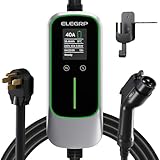
- Fast & Adjustable Charging: Up to 9.6 kW (37 mph), 7x faster than Level 1, with 5 current levels (16/20/24/32/40A) to match home capacity, plus 1–12H timing delay for off-peak charging, reducing costs and easing range anxiety
- Plug & Extended Reach: NEMA 14-50 plug fits 240V outlets for true plug-and-play use, while the 25FT cable offers flexible reach across garages and driveways, eliminating the need to reposition vehicles for easier daily charging
- ETL Certified & ELEGRP PBE Protection: Fully ETL certified, ELEGRP’s exclusive PBE technology combines full-link overheat protection with a triple-layer safety system, ensuring safer, more efficient charging. Includes a 2-year warranty
- All-Weather Indoor & Outdoor Use: IP67-rated for durability in rain, snow, and extreme temps (-21°F to 121°F), with a portable design that supports home, travel, and outdoor charging, delivering reliable performance anywhere
- Universal Compatibility: Works seamlessly with Mercedes, Chevy, Ford, Mustang Mach-E, Cadillac, Hyundai Ioniq, Kia EV6/EV9, Nissan Leaf, Chevy Bolt, Chrysler Pacifica Hybrid, and all PHEV/BEV. Tesla compatible with NACS adapter (sold separately)
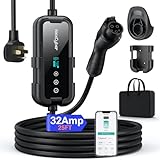
- [Up to 6X Faster Charging Speed via the NEMA 14-50 plug (32 amp)]: Provides up to 24 miles/hour charging speed via the NEMA 14-50 plug (32 amp). Professional installation recommended for optimal safety and performance. [Use the 5-15P Adapter]: 1. The RV Adapter doesn't work for EV chargers, please choose the EV adapter. 2. It will become slow level 1 ev charging and some cars may drop to 12A, the max charging rate is 1.32-1.8kW(110V*12A-120V*15A).
- [Equipped with J1772 Connector for All North America j1772 Connector EVs/PHEVs. Not fits for Tesla/Nacs Connector Cars(j1772 to Tesla adapter needed)]: Compatible with Tesla cars (Adapter needed, not included), Ford, GM, Audi, Kia, Honda, Kia, Hyundai, Gmc, Chevrolet Bolt, VW ID 4, Nissan Leaf, Ford Mustang Mach-E, IONIQ 5 2024 and before, BMW i3, i4, iX, Jeep Wrangler 4xe, etc. [Not fits for Nac connector cars-Kia EV6 2025,Ariya 2025&2025 loniq 5(J1772 to Tesla adapter needed)]
- [Safety & Faster Charging with ETL, FCC Certified]: Meets the Safety Criteria Defined by: SAE J1772, UL2231-1/-2, UL 991, UL 2231, UL 2251, UL1998 and UL 2594. (ETL and FCC certified EV car charger with 3-year Warranty)
- [Plug-play Mode(The Default Setting), Smart Touch Screen, No APP Needed]: Clearly show the charging amperage, charging speed, input voltage, delay time, etc. For the touch buttons: 1. Pull out the charging gun before press the buttons, otherwise no respond; 2. Long press "Ⓐ" or "Time" button to enter the setting interface, then you can adjust the amperage from 16A to 32A freely or Set the charging start time; 3. You can do "factory reset" if doesn't charging.
- [Smart WIFI APP, You can Set the Charging Period]: By APP, you can wirelessly check the charging cost, history, fully-charged notification, track the charging status, during off-peak period, etc. [Wi-Fi Reset/Factory Reset Function, Add New Device Quickly]: If you can't find your device or you have replaced a new phone, just pull out the charging latches, simultaneously long press the Ⓐ button and time adjustment button on the product screen until it shows "Factory Reset", then wait 3-5 seconds and re-start your device.


- 【Efficient Charging】VDLPOWERVP level 2/level 1 EV charger is equipped with NEMA 6-20 Plug(220V/240V), it offers 16A current and up 3.5kW output. Two charging options, low current charging can effectively reduce battery wear and prolong service life. Choosing to connect the conversion line for charging can realize a full day's commute mileage in one night.
- 【Level 1 & Level 2 EV Charger Adapter】This portable ev charger is equipped with NEMA 6-20 plug (Level 2, 240V, 16A) and NEMA 5-15 adapter (Level 1, 110V, 12A), you can connect our electric vehicle chargers to a standard household socket or a dedicated industrial socket, use it flexibly from anywhere in the garage or driveway.
- 【Intelligent Charging-Durable and Safe】The intelligent chip design of its control box can keep monitoring the charging status at any time, provides multiple safety protections such as lightning protection and leakage protection. This electric vehicle charger is made of premuim and sturdy materials and is FCC certified. EV Control box is IP65 waterproof and dustproof.
- 【Easy Charging and Indication Displays】Just connect to the outlet and the car, the ev charger can work properly. LED indicators that can tell you the status as well as indicate errors while charging your electric vehicle. It can help you get the charging station status information quickly.
- 【Portable Design】The ev charger has a 20ft charge cable, which is long enough for you to charge without getting tangled.The appropriate cord length and weight allow you to easily put it in the trunk of an electric car whether you are visiting friends or renting a vacation house.
This product presentation was made with AAWP plugin.