
October 27, 2021 NHTSA CAMPAIGN NUMBER: 21V840000
Reduced braking performance can extend the distance required to stop the vehicle, increasing the risk of a crash.
NHTSA Campaign Number: 21V840
Manufacturer Hyundai Motor America
Components SERVICE BRAKES, HYDRAULIC
Potential Number of Units Affected 995
Summary
Hyundai Motor America (Hyundai) is recalling certain 2021 Palisade vehicles. The brake fluid may be contaminated, which can cause the brake master cylinder inner-cup seals to swell, and reduce braking performance.
Remedy
Dealers will replace the brake master cylinder, and flush the brake fluid, free of charge. Owner notification letters were mailed on December 24, 2021. Owners may contact Hyundai customer service at 1-855-371-9460. Hyundai’s number for this recall is 212.
Notes
Owners may also contact the National Highway Traffic Safety Administration Vehicle Safety Hotline at 1-888-327-4236 (TTY 1-800-424-9153), or go to www.nhtsa.gov.
Check if your Hyundai has a Recall

Description: This bulletin describes the procedure to drain brake fluid and replace the brake master cylinder on certain 21MY Palisade (LX2) models. The brake fluid in the subject vehicles may be contaminated with mineral oil causing the brake master cylinder inner cup seals to expand. Expanded brake master cylinder inner cup seals could reduce hydraulic pressure applied by the master cylinder resulting in reduced braking function at the wheels. The driver may experience longer brake pedal travel, change in pedal feel, and extended stopping distance, increasing the risk of a crash.
Applicable Vehicles: 21MY Palisade (LX2) vehicles produced from March 9, 2021 through March 31, 2021.
Parts Information:
| PART NAME / IMAGE | PART NUMBER | REMARKS |
| Brake Master Cylinder | 58510-C5070-QQH | |
| DOT 4 Brake Fluid | 00232-19053 | 12 bottles per QTY 1 of P/N 00232-19053 12 oz. / 355 mL per bottle 2 liters (6 bottles) required per vehicle |
SST Information
| NAME | PART NUMBER | PHOTO | REMARKS |
| Air Bleeding Tool | 09580-3D100 |
| |
| Active Hydraulic Boost (AHB) Brake Air Bleeding Tool Adapter | 09580-3D200 |
Service Procedure: Flowchart Overview
Service Procedure: (Refer to the QR link for additional video information)
Hyundai Service Learning – Recall 212 Service Procedure
1. Place the vehicle on a lift with an assistant seated in the driver’s seat.
Open the hood.
2. Discharge as much brake fluid as possible from the system according to the steps below.
NOTICE
Perform this operation in this order:
1) Rear Right
2) Front Left
3) Rear Left
4) Front Right
3. Starting at the rear right caliper, remove the bleed screw cover.
4. Connect one end of a bleed line to the bleeder screw, and the other end into a container to collect the brake fluid.
Open the bleed screw and have the assistant inside the vehicle pump the brake pedal to discharge the brake fluid.
Continue until the caliper is completely discharged of brake fluid.
Close the bleeder screw.
5. Move to the next caliper (front left) and repeat step #4 to discharge the brake fluid.
6. Repeat step #4 on the rear left caliper, then the front right.
7. Lower the vehicle and fill the brake fluid reservoir to the MAX line with DOT 4 brake fluid.
CAUTION
- Clean the area around the reservoir cap of any foreign substances before removing the cap.
- Be careful not to contaminate brake fluid with dust or other foreign substances.
- Do not allow brake fluid to come into contact with the vehicle body/paint. Immediately wipe any spills and flush with water if contact does occur.
8. Connect the air bleeding tool and adapter SST to the master cylinder.
Apply compressed air, and set the pressure to 3 bar (43.5 psi).
9. Connect a GDS to the vehicle and perform the HCU Air Bleeding Mode (under S/W Management → ABS/ESP).
10. Follow the directions for the HCU Air Bleeding Mode procedure on the GDS.
By the completion of the procedure, each caliper should have discharged fluid in these amounts:
Each front caliper: 100 mL
Each rear caliper: 150 mL
By the completion of the procedure, the master cylinder reservoir should be completely emptied of any brake fluid.
If any brake fluid remains, repeat the HCU Air Bleeding Mode procedure until completely empty.
11. Record the customer’s AM/FM/satellite radio station presets.
Turn the vehicle’s ignition to OFF.
Remove the battery by disconnecting the negative battery terminal, then the positive terminal, then the tie-down clamp.
Remove the air cleaner assembly according to the service manual procedures:
Engine Mechanical System → Intake and Exhaust System → Air Cleaner
12. Disconnect the brake fluid level sensor connector.
Remove and replace the brake master cylinder according to the service manual procedures:
Brake System → Brake System → Master Cylinder
NOTICE
The replacement master cylinder includes a new, preinstalled O-ring.
Before installing the new master cylinder, be sure to remove the original O-ring if it is left attached to the brake booster.
13. After installing the new master cylinder, fill the reservoir with DOT 4 brake fluid to the MAX line.
14. Bleed all four calipers starting with the rear right caliper. Connect a bleeding tube to the caliper bleed screw, leading to a collection container:
1. An assistant seated in the driver’s seat presses and releases the brake pedal several times, then holds the pedal depressed.
2. With the pedal depressed, open the bleeder screw to release air/fluid into the container.
3. Repeat #1 and #2 until no bubbles remain in the line.
4. Move to the next caliper and repeat the process until air is removed from all 4 lines.
NOTICE
Refer to the service manual for brake bleeding procedures:
Brake System → Brake Bleeding Procedures
15. Fill the brake fluid reservoir to the MAX line.
Connect the air bleeding tool and adapter SST to the master cylinder.
Apply compressed air and set the pressure to 3 bar (43.5 psi).
Connect a GDS to the vehicle and perform the HCU Air Bleeding Mode (under S/W Management → ABS/ESP).
Follow the directions for the HCU Air Bleeding Mode procedure on the GDS.
Repeat this process for all 4 calipers in the correct order.
Refill the brake fluid reservoir to the MAX line.
16. Using the GDS, perform a brake system pressure check:
From the starting screen, select Data Analysis.
17. Select ABS/ESC system.
18. Watch the three brake pressure parameters while gradually depressing the brake pedal:
1) Pressure Sensor – Pressure
2) Primary Pressure Sensor
3) Secondary Pressure Sensor
This operation should take about 20 seconds. Be sure to press the pedal very firmly to reach full braking pressure.
Confirm that the brake pressure values rise when gradually depressing the brake pedal.
The service procedure is complete after verification of brake pressure.
Reconnect the negative battery terminal and re-program the customer’s AM/FM/satellite radio station presets.
NOTICE
If proper brake pressure/operation is not achieved, perform the brake bleeding process again for both Normal Brake System and ESC Brake System.
Refer to the service manual for brake bleeding procedures:
Brake System → Brake Bleeding Procedures
Customer FAQ
Q1: What is the safety concern?
A1: Extended stopping distance could increase the risk of a crash.
Q2: What will be done during the recall service at the dealer?
A2: All owners of the subject vehicles will be notified by first class mail with instructions to bring their vehicles to a Hyundai dealer to have the brake fluid flushed and brake master cylinder replaced.
This remedy procedure will be performed at no charge. Hyundai will provide reimbursement to owners for repairs according to the plan submitted to NHTSA on May 16, 2018.
Customer Notification
Owners will be notified beginning in late December 2021/early January 2022. NHTSA has posted this recall.
Chronology :
September 2021
On September 2, 2021, HMC informed HMA’s NASO of an investigation being conducted in Korea involving eleven (11) Korean domestic vehicles produced from March 9, 2021 through March 31, 2021 for potential contamination of the brake fluid. NASO searched its field information databases and found three (3) unique U.S. vehicle incidents reporting a low or spongey brake pedal. NASO recovered and shipped two (2) brake master cylinder units from the identified incidents for further testing by the supplier in Korea.
On September 22, 2021, NASO shared its investigation status with NHTSA’s ODI during its recurring monthly review of safety-related topics.
October 2021
On October 14, 2021, HMC informed NASO of the parts analysis results confirming the presence of mineral oil in the brake fluid of the incident brake master cylinders and the ensuing effect on the brake master cylinder’s inner cup seal causing low braking ability due to reduced internal pressure. Based on this information, on October 19, NASO convened its North American Safety Decision Authority and decided to conduct a safety recall of vehicles produced in the subject date range for further evaluation into root cause of the brake fluid contamination. The investigation will actively continue to determine if a specific root cause and defect trend exists.
As of the date of this filing, Hyundai is not aware of any crashes, fires, or injuries related to the defect condition in the U.S.
1 Affected Product
Vehicle
| MAKE | MODEL | YEAR |
| HYUNDAI | PALISADE | 2021 |
9 Associated Documents
Recall Acknowledgement
RCAK-21V840-5164.pdf 646.265KB
Defect Notice 573 Report
RCLRPT-21V840-4115.PDF 214.168KB
Recall 573 Report – Amendment 1
RCLRPT-21V840-2325.PDF 214.221KB
Manufacturer Notices(to Dealers,etc) – Recall 212: BRAKE MASTER CYLINDER – Dealer Best Practice (TSB # 21-01-081H): December 22, 2021
RCMN-21V840-4364.pdf 399.582KB
Remedy Instructions and TSB
RCRIT-21V840-5699.pdf 4327.934KB
Owner Notification Letter(Part 577) – December 24, 2021
RCONL-21V840-2869.pdf 172.772KB
Recall Quarterly Report #1, 2021-4
RCLQRT-21V840-8194.PDF 211.123KB
Recall Quarterly Report #3, 2022-2
RCLQRT-21V840-8106.PDF 211.312KB
Recall Quarterly Report #4, 2022-3
RCLQRT-21V840-9880.PDF 211.417KB
Latest Recalls Documents

- Complete Kit: The brake system bleeding tools contain 2*6.02" long inlet hose, 2*13.77" long outlet hose, 2*check valve, 4*0.24" ID small clamps, 2*0.31" ID large clamps, 6*bleeder screw caps. Fit for hydraulic brakes on most motorcycles, cars, and bikes
- One-Way Check Values: The check valve of this brake bleed kit is precisely designed, which can avoid air, dust, and impurities from entering the motorcycle's braking system, keeps internal cleanliness. and provide you with 4 clamps to avoid oil spillage
- Dust-Proof Screw Caps: The screw caps of the brake bleeding kit is made of flexible rubber, can avoids dust and grease from accumulating on the bleeder screw, allows the bleeder screw to release excess gas in the event of high pressure inside the caliper
- Durable Materials: The valves of reverse brake bleeder kit are made of aluminum, not easy to rust, and the bendable rubber hose is high temperature resistance and not easy to deform, adaptable to the curved line layout of the braking system
- Easy to Install: Our car brake bleed kit is easy to use, connect the check valve to the hose, and then connect the hose to the bleeder nozzle, let you start the bleed work of the vehicle, the detailed steps can be found in the description of details

- Specifications: The Brake Bleeder bottles can simply drain old brake fluid, rubber joints fit most bleeding screws, 60 cm (24 in) hose and chain with hooks to hold in place while collecting old brake fluid
- One-Way Valve: Features a precision-designed check valve to ensure a perfect seal and precise brake fluid control, preventing old brake fluid backflow and air from entering the system
- Material: This brake fluid bleeding kit is made of high-rigidity plastic, with a corrosion-resistant check valve and high-temperature-resistant hose for extended service life
- Compatibility: Brake Bleeding Fluid Bottle fit all brake systems, including cars, motorcycles, ATVs, dirt bikes and scooters. It works better with our 4 L manual brake fluid bleeder
- Excellent Customer Service: We provide comprehensive customer service to ensure that you can get timely and professional solutions to any problems you may encounter during use

- Brake booster kit comes with a vacuum gauge that can be widely used to test vehicle vacuum systems/as a vacuum sealer. Equipped with a vacuum gauge to help you take accurate readings. Pressure range: 0-30 in/Hg, 0-760 mm/Hg
- The hose is made from premium material for resilience, heat resistance and reliable sealing performance, The contoured design of the handle gives you a firm grip during use, so you can operate quickly and comfortably
- Handheld Vacuum Pump Kit comes complete with accessories. Includes handheld vacuum pump with vacuum gauge, 4.05 OZ reservoir jar, 4 transparent hoses, 3 different adapters and connectors included to allow you to use this tool kit on cars, bikes, motorcycles and other vehicles
- DURATECH brake system bleeding tools enable you to check vacuum operated automotive components, bleeding air from hydraulic systems and siphoning fluids. Creates both pressure and vacuum, it will help make an automotive repair or maintenance task easier
- All the tools and accessories are centrally compactly put on a built-in case. Perfect for both home and business applications and easy to transport and store
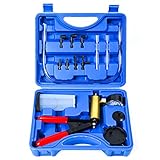
- Versatile: Brake bleeder kit comes with a vacuum gauge to help you take accurate readings. Pressure range: 0-30 inches Hg, 0-760 mmHg. It includes accessories for brake bleeding and automotive diagnostics.
- EASY TO OPERATE: Our Brake bleeder kit is suitable for pumping out air, oil, steering fluid and other fluids and directing new oil to fill the entire system. The best part is that you can operate the bleeder yourself without any assistant!
- EASY TO CARRY: The vacuum pump kit case is made of high quality plastic material, simple and lightweight, durable and strong enough. Easy to transport and store for home and commercial applications.
- COMPLETE ACCESSORIES: Handheld vacuum pump kit includes hand pump with gauge, 4 clear hoses, 4.5OZ reservoir, 8 adapters and portable case for all your needs.
- SATISFACTION GUARANTEED: We take responsibility for every product. If you have any questions about our products or services, please contact us immediately and we will give you a satisfactory solution!

- Efficient Brake and Clutch Fluid Bleeding: Designed for use with DOT 4 or other common brake fluids, this tool enables fast, one-person bleeding of hydraulic systems without backflow or fluid waste
- One Way Check Valve for Air-Free Operation: Features a built-in one way valve that allows brake fluid to flow in one direction only, preventing air from re-entering your brake or clutch system during bleeding
- Durable Aluminum and Soft Tube Construction: Made with a corrosion-resistant aluminum body and flexible transparent tube, this brake bleeder hose is designed to withstand frequent use and brake fluid exposure without degrading
- Quick and Secure Attachment: Equipped with durable metal clips, the hose can be easily clipped onto brake bleeder nipples for a firm and leak-free connection, ensuring a clean and simple bleeding process
- Wide Compatibility Across Vehicles: Perfect for motorcycles, cars, ATVs, and scooters, this universal brake bleeder kit is ideal for both home mechanics and professional garage use in fluid replacement and brake servicing
SEOCONTENT-START
Circulate To: General Manager, Service Manager, Parts Manager, Warranty Manager, Service Advisors, Technicians, Body Shop Manager, Fleet Repair Technical Service Bulletin GROUP NUMBER RECALL 21-01-081H DATE MODEL(S) DECEMBER, 2021 PALISADE (LX2) SUBJECT: PALISADE BRAKE MASTER CYLINDER (RECALL CAMPAIGN 212) Description: This bulletin describes the procedure to drain brake fluid and replace the brake master cylinder on certain 21MY Palisade (LX2) models. The brake fluid in the subject vehicles may be contaminated with mineral oil causing the brake master cylinder inner cup seals to expand. Expanded brake master cylinder inner cup seals could reduce hydraulic pressure applied by the master cylinder resulting in reduced braking function at the wheels. The driver may experience longer brake pedal travel, change in pedal feel, and extended stopping distance, increasing the risk of a crash. Applicable Vehicles: 21MY Palisade (LX2) vehicles produced from March 9, 2021 through March 31, 2021. *** Dealer Stock and Retail Vehicles *** As required by federal law, dealer must not deliver new vehicles for sale or for lease to customers until all open recalls have been performed. Dealers must also perform all open recalls on used vehicles, demo, and rental vehicles prior to placing them into customer use and whenever an affected vehicle is in the shop for any maintenance or repair. When a vehicle arrives at the service department, access Hyundai Motor America’s “Vehicle Information” screen via WEBDCS to identify open Campaigns. IMPORTANT PALISADE (LX2) BRAKE MASTER CYLINDER RECALL 212 TSB #: 21-01-081H Page 2 of 12 SUBJECT: SUBJECT: Parts Information: PART NAME / IMAGE PART NUMBER REMARKS Brake Master Cylinder 58510-C5070-QQH DOT 4 Brake Fluid 00232-19053 12 bottles per QTY 1 of P/N 00232-19053 12 oz. / 355 mL per bottle 2 liters (6 bottles) required per vehicle SST Information NAME PART NUMBER PHOTO REMARKS Air Bleeding Tool 09580-3D100 • Use as directed in the vehicle’s shop manual or TSB(s). • Previously provided to all dealers as essential tools. • To order a replacement contact Bosch: 1-866-539-4248 Active Hydraulic Boost (AHB) Brake Air Bleeding Tool Adapter 09580-3D200 Warranty Information: MODEL OP. CODE OPERATION OP. TIME CAUSAL PART NATURE CAUSE Palisade (LX2) 11D189R0 Brake oil and master cylinder replacement 1.4 M/H 58510-C5070- QQH D75 ZZ3 NOTE 1: Submit Claim on Campaign Claim Entry Screen NOTE 2: If a part that is not covered by Recall 212 is found in need of replacement while performing Recall 212 and the affected part is still under warranty, submit a separate claim using the same Repair Order. If the affected part is out of warranty submit a Prior Approval Request for goodwill consideration prior to performing the work. NOTE 3: The incident part may be subject to callback through the normal Warranty Technical Center (WTC) parts return process. PALISADE (LX2) BRAKE MASTER CYLINDER RECALL 212 TSB #: 21-01-081H Page 3 of 12 SUBJECT: SUBJECT: Service Procedure: Flowchart Overview Vehicle in Drain brake fluid (all four calipers) Fill brake fluid reservoir Using GDS, perform HCU Air Bleeding Mode Replace brake master cylinder Fill brake fluid reservoir Air bleed Using GDS, perform HCU Air Bleeding Mode Fill brake fluid reservoir Vehicle out GDS pressure Low pressure OK Fill brake fluid reservoir PALISADE (LX2) BRAKE MASTER CYLINDER RECALL 212 TSB #: 21-01-081H Page 4 of 12 SUBJECT: SUBJECT: Service Procedure: (Refer to the QR link for additional video information) Hyundai Service Learning – Recall 212 Service Procedure 1. Place the vehicle on a lift with an assistant seated in the driver’s seat. Open the hood. 2. Discharge as much brake fluid as possible from the system according to the steps below. Perform this operation in this order: 1) Rear Right 2) Front Left 3) Rear Left 4) Front Right NOTICE PALISADE (LX2) BRAKE MASTER CYLINDER RECALL 212 TSB #: 21-01-081H Page 5 of 12 SUBJECT: SUBJECT: 3. Starting at the rear right caliper, remove the bleed screw cover. 4. Connect one end of a bleed line to the bleeder screw, and the other end into a container to collect the brake fluid. Open the bleed screw and have the assistant inside the vehicle pump the brake pedal to discharge the brake fluid. Continue until the caliper is completely discharged of brake fluid. Close the bleeder screw. 5. Move to the next caliper (front left) and repeat step #4 to discharge the brake fluid. 6. Repeat step #4 on the rear left caliper, then the front right. PALISADE (LX2) BRAKE MASTER CYLINDER RECALL 212 TSB #: 21-01-081H Page 6 of 12 SUBJECT: SUBJECT: 7. Lower the vehicle and fill the brake fluid reservoir to the MAX line with DOT 4 brake fluid. 8. Connect the air bleeding tool and adapter SST to the master cylinder. Apply compressed air, and set the pressure to 3 bar (43.5 psi). Brake fluid MAX line • Clean the area around the reservoir cap of any foreign substances before removing the cap. • Be careful not to contaminate brake fluid with dust or other foreign substances. • Do not allow brake fluid to come into contact with the vehicle body/paint. Immediately wipe any spills and flush with water if contact does occur. ! CAUTION PALISADE (LX2) BRAKE MASTER CYLINDER RECALL 212 TSB #: 21-01-081H Page 7 of 12 SUBJECT: SUBJECT: 9. Connect a GDS to the vehicle and perform the HCU Air Bleeding Mode (under S/W Management → ABS/ESP). 10. Follow the directions for the HCU Air Bleeding Mode procedure on the GDS. By the completion of the procedure, each caliper should have discharged fluid in these amounts: Each front caliper: 100 mL Each rear caliper: 150 mL By the completion of the procedure, the master cylinder reservoir should be completely emptied of any brake fluid. If any brake fluid remains, repeat the HCU Air Bleeding Mode procedure until completely empty. Each front caliper (100mL) Each rear caliper (150mL) PALISADE (LX2) BRAKE MASTER CYLINDER RECALL 212 TSB #: 21-01-081H Page 8 of 12 SUBJECT: SUBJECT: 11. Record the customer’s AM/FM/satellite radio station presets. Turn the vehicle’s ignition to OFF. Remove the battery by disconnecting the negative battery terminal, then the positive terminal, then the tie-down clamp. Remove the air cleaner assembly according to the service manual procedures: Engine Mechanical System → Intake and Exhaust System → Air Cleaner 12. Disconnect the brake fluid level sensor connector. Remove and replace the brake master cylinder according to the service manual procedures: Brake System → Brake System → Master Cylinder Negative battery terminal Brake fluid level sensor The replacement master cylinder includes a new, preinstalled O-ring. Before installing the new master cylinder, be sure to remove the original O-ring if it is left attached to the brake booster. NOTICE O-ring Positive battery terminal PALISADE (LX2) BRAKE MASTER CYLINDER RECALL 212 TSB #: 21-01-081H Page 9 of 12 SUBJECT: SUBJECT: 13. After installing the new master cylinder, fill the reservoir with DOT 4 brake fluid to the MAX line. 14. Bleed all four calipers starting with the rear right caliper. Connect a bleeding tube to the caliper bleed screw, leading to a collection container: 1. An assistant seated in the driver’s seat presses and releases the brake pedal several times, then holds the pedal depressed. 2. With the pedal depressed, open the bleeder screw to release air/fluid into the container. 3. Repeat #1 and #2 until no bubbles remain in the line. 4. Move to the next caliper and repeat the process until air is removed from all 4 lines. Brake fluid MAX line Refer to the service manual for brake bleeding procedures: Brake System → Brake Bleeding Procedures NOTICE PALISADE (LX2) BRAKE MASTER CYLINDER RECALL 212 TSB #: 21-01-081H Page 10 of 12 SUBJECT: SUBJECT: 15. Fill the brake fluid reservoir to the MAX line. Connect the air bleeding tool and adapter SST to the master cylinder. Apply compressed air and set the pressure to 3 bar (43.5 psi). Connect a GDS to the vehicle and perform the HCU Air Bleeding Mode (under S/W Management → ABS/ESP). Follow the directions for the HCU Air Bleeding Mode procedure on the GDS. Repeat this process for all 4 calipers in the correct order. Refill the brake fluid reservoir to the MAX line. PALISADE (LX2) BRAKE MASTER CYLINDER RECALL 212 TSB #: 21-01-081H Page 11 of 12 SUBJECT: SUBJECT: 16. Using the GDS, perform a brake system pressure check: From the starting screen, select Data Analysis. 17. Select ABS/ESC system. PALISADE (LX2) BRAKE MASTER CYLINDER RECALL 212 TSB #: 21-01-081H Page 12 of 12 SUBJECT: SUBJECT: 18. Watch the three brake pressure parameters while gradually depressing the brake pedal: 1) Pressure Sensor – Pressure 2) Primary Pressure Sensor 3) Secondary Pressure Sensor This operation should take about 20 seconds. Be sure to press the pedal very firmly to reach full braking pressure. Confirm that the brake pressure values rise when gradually depressing the brake pedal. The service procedure is complete after verification of brake pressure. Reconnect the negative battery terminal and re-program the customer’s AM/FM/satellite radio station presets. If proper brake pressure/operation is not achieved, perform the brake bleeding process again for both Normal Brake System and ESC Brake System. Refer to the service manual for brake bleeding procedures: Brake System → Brake Bleeding Procedures NOTICE
**************************************************************************************************************
This notice applies to your Hyundai, VIN: Dear This notice is sent to you in accordance with the National Traffic and Motor Vehicle Safety Act. Hyundai has discovered a defect which relates to motor vehicle safety exists in your vehicle, with the VIN shown above. Hyundai is initiating a safety recall to repair a condition involving the service brake system in certain model year 2021 Hyundai Palisade vehicles in the U.S. and Canada. What is the problem? The brake fluid in the subject vehicles may be contaminated with mineral oil causing the brake master cylinder inner cup seals to expand. The cause of the contamination is under active investigation. Expanded brake master cylinder inner cup seals could reduce hydraulic pressure applied by the master cylinder resulting in reduced braking function at the wheels. The driver may experience longer brake pedal travel, change in pedal feel, and extended stopping distance, increasing the risk of a crash. What will Hyundai do? Your Hyundai dealer will have the brake fluid flushed and brake master cylinder replaced. This procedure will be performed at NO CHARGE to you. What should you do? Please contact your nearest Hyundai dealer to schedule the recall repair as soon as possible. If the Malfunction Indicator Light is illuminated in your vehicle, you should seek service at your Hyundai dealer as soon as possible. The actual time required to perform the repair will take approximately one hour and a half. However your vehicle may be needed longer. Therefore, we recommend scheduling a service appointment to minimize inconvenience. If you have other questions If you require further assistance, you may contact the Hyundai Customer Care Center at 1-855-371-9460. If you believe that the dealer or Hyundai has failed or is unable to remedy the defect within a reasonable time, you may submit a complaint to the Administrator, National Highway Traffic Safety Administration, 1200 New Jersey Avenue S.E., Washington, D.C. 20590, or call the toll free Vehicle Safety Hot Line at 1-888-327-4236 (TTY: 1-800-424-9153), or go to https://www.safercar.gov. Thank you for your attention to this important safety matter. We apologize for any inconvenience this may have caused you. Hyundai Motor America Hyundai Motor America P.O. Box 20839 Fountain Valley, CA 92728-9937 IMPORTANT SAFETY RECALL 2021 Palisade Low Brake Pedal Importante Retiro del Mercado por Motivos de Seguridad — Si tiene preguntas llama 1-800-633-5151 y oprima “8” NHTSA Recall Number: 21V-840 Hyundai Recall Number: 212 This is an important Safety Recall. • Please contact your nearest Hyundai dealer to schedule the repair as soon as possible. • This repair will be performed at NO CHARGE to you. • To locate your nearest Hyundai dealer and schedule your appointment please visit: www.HyundaiUSA.com/Campaign212
**************************************************************************************************************
Recall 212: BRAKE MASTER CYLINDER – Dealer Best Practice (TSB # 21-01-081H) December 22, 2021 Updates to this Document Date • TSB # 21-01-081H – Remedy Available 12/22/2021 As required by federal law, dealers must not deliver new vehicles for sale or for lease to customers until all open recalls have been performed. Dealers must also perform all open recalls on used vehicles, demo, and rental vehicles prior to placing them into customer use and whenever an affected vehicle is in the shop for any maintenance or repair. Description of Campaign: The brake fluid in the subject vehicles may be contaminated with mineral oil causing the brake master cylinder inner cup seals to expand. Expanded brake master cylinder inner cup seals could reduce hydraulic pressure applied by the master cylinder resulting in reduced braking function at the wheels. The driver may experience longer brake pedal travel, change in pedal feel, and extended stopping distance, increasing the risk of a crash. Follow the TSB# 21-01-081H for the procedure to drain the brake fluid and replace the brake master cylinder. Affected Vehicles: • Certain 2021 model year Hyundai Palisade (LX2) produced from March 9, 2021 to March 31, 2021 by Hyundai Motor Company (“HMC”) in Korea To check vehicle specific recall and campaign applicability, access the “Vehicle Information” screen via WebDCS. Remedy Information: Hyundai dealers will drain the brake fluid and replace the vehicles’ brake master cylinder per the procedures outlined in TSB # 21-01-081H. • Estimated Repair Time (Based on Warranty Op Time): Up to 1.4 hours. • Recommended Technician Training Level: Certified o Technician should also have completed the Special Service Tools – Classroom (SCSST38_203) or equivalent training Recommended Alternative Transportation: It is advisable to have an SRC or other form of alternative transportation reserved for the customer(s) in anticipation of the vehicle remaining at the dealership for additional repairs. Best Practice Checklist Reservation: Did you check WebDCS for additional campaigns or recalls?
SEOCONTENT-END
This product presentation was made with AAWP plugin.