
March 12, 2018 NHTSA CAMPAIGN NUMBER: 18V166000
Voltage Protection Device Improper Activation
If the VPD activates while the vehicle is being operated in Electric Vehicle (EV) mode, there may be a loss of power, increasing the risk of a crash.
NHTSA Campaign Number: 18V166
Manufacturer Hyundai Motor America
Components HYBRID PROPULSION SYSTEM
Potential Number of Units Affected 2,840
Summary
Hyundai Motor America (Hyundai) is recalling certain 2016-2018 Hyundai Sonata Plug-In Hybrid vehicles. These vehicles are equipped with a Voltage Protection Device (VPD), designed to protect the high voltage battery module, that may activate inadvertently.
Remedy
Hyundai will notify owners, and dealers will remove the VPD switch and install a new Battery Management System (BMS) that contains an Overvoltage Protection Device (OPD). The recall is expected to begin May 2018. Owners may contact Hyundai customer service at 1-855-371-9460. Hyundai’s number for this recall is 175.
Notes
Owners may also contact the National Highway Traffic Safety Administration Vehicle Safety Hotline at 1-888-327-4236 (TTY 1-800-424-9153), or go to www.safercar.gov.
Check if your Hyundai has a Recall
Recall 175 Dealer Best Practice
Date: March 22, 2018
Attn: Dealer Principal/General Manager/Service Manager/Parts Manager
Subject: Recall 175: 2016-2018 Sonata Plug-In Hybrid Voltage Protection Device (Remedy Not Yet Available)
***IMPORTANT Dealer Stock and Retail Vehicles***
As required by federal law, dealers must not deliver new vehicles for sale or for lease to customers until all open recalls have been performed. Dealers should also perform all open recalls on used vehicles, demo and rental vehicles prior to placing them into customer use and whenever an affected vehicle is in the shop for any maintenance or repair.
Affected Vehicles
Hyundai has announced, but not yet launched, a safety recall in the United States to replace the Voltage Protection Device (“VPD”) in certain:
- 2016-2018 Hyundai Sonata Plug-in Hybrid vehicles produced from July 31, 2015 through August 31, 2017 by Hyundai Motor Company (“HMC”) in South Korea.
Description
The subject vehicles are equipped with a Voltage Protection Device (“VPD”) designed to monitor the hybrid battery’s state of charge and safeguard the hybrid battery from overvoltage by disconnecting the power to the electric motor. In limited instances, during the charging/discharging process, the hybrid battery could swell and inadvertently activate the VPD switch. If the VPD switch is activated while the vehicle is driven in the Electric Vehicle (“EV”) drive mode, the electric motor could become inoperative and the vehicle could lose motive power.
Service Action
- We are currently making preparations to implement the recall remedy. A Technical Service Bulletin (TSB) will be provided when the remedy is available.
- For any customers that are currently experiencing a concern related to this recall, please confirm with Hyundai Techline that there are no revised instructions.
- Refer to the below Customer FAQ section.
Parts
- Additional details will be provided when the recall remedy is available.
Customer Notification
This recall has been posted to the NHTSA website, and you may receive phone calls from customers with questions regarding this matter. Hyundai will notify all owners of the vehicles described above to return their vehicles to their Hyundai dealers for repair once the remedy is available. Customer notification letters of the recall are scheduled to be mailed in early May, 2018.
Thank you for your prompt attention to this important safety matter and continued commitment to taking care of Hyundai customers.
Hyundai Motor America
Customer FAQ
| Q1: | What is the issue? |
| A1: | The subject vehicles are equipped with a Voltage Protection Device (“VPD”) designed to monitor the hybrid battery’s state of charge and safeguard the hybrid battery from overvoltage by disconnecting the power to the electric motor. In limited instances, during the charging/discharging process, the hybrid battery could swell and inadvertently activate the VPD switch. |
| Q2: | What is the safety concern? |
| A2: | If the VPD switch is activated while the vehicle is driven in the Electric Vehicle (“EV”) drive mode, the electric motor could become inoperative and the vehicle could lose motive power increasing the risk of a crash. |
| Q3: | What are the affected vehicles? |
| A3: | Approximately 2,840 model year 2016 – 2018 Hyundai Sonata Plug-in Hybrid vehicles produced between 07/31/2015 and 08/31/2017 by Hyundai Motor Company in South Korea. |
| Q4: | Have there been any accidents or injuries? |
| A4: | Hyundai is not aware of any accidents or injuries related to this condition. |
| Q5: | What will be done during the recall service? |
| A5: | Hyundai plans to remove the current VPD switch and install a new Battery Management System (“BMS”) module containing an Overvoltage Protection Device (“OPD”) switch. Hyundai is currently making preparations to implement the recall remedy. |
| Q6: | Should customers have their vehicles inspected at their dealer to make sure they are safe? |
| A6: | If a customer owns an affected vehicle, they will receive written notification of the recall by first class mail. In the interim, if the customer experiences a “Check Hybrid System” warning light, they should seek service at their Hyundai dealer as soon as possible. |
| Q7: | When will owners be notified? |
| A7: | Hyundai will begin notifying owners of the affected vehicles no later than May, 2018. In the meantime, updated information about this recall can be found at www.hyundaiusa.com/campaign175 . |
| Q8: | Can the recall service be performed now? (prior to receiving notice) |
| A8: | No. Hyundai is currently making preparations to implement the recall remedy. Once a remedy becomes available, Hyundai will notify customers of the affected units. |
| Key Contact Information | ||
| Dealer Support | Contact Information | Description |
| Parts | [email protected] 1-800-545-4515 | Parts ordering hotline |
| Techline | 1‐800‐325‐6604 | Vehicle Technical Support for Hyundai Dealer Technicians |
| Warranty HELPREP Line | 1‐877‐446‐2922 | Warranty Claim questions for Hyundai Dealers |
| Warranty Prior Approval (PA) Center | 1‐844-371-3808 | Warranty Prior Approval (PA) Center for Hyundai Dealers |
| Xtime Technical Support | [email protected] 1‐866‐984‐6355 | Assistance with Car Care Scheduling:
• Appointment / Shop Capacity Management / Campaign Integration / Operation Codes |
| Customer Support | Contact Information | Description |
| Hyundai Customer Care Center (Recall / Campaign Questions) | 1‐855‐671‐3059 | Customer questions or concerns related to recall or service campaigns |
| Hyundai Recall / Campaign Website | www.hyundaiusa.com/campaign175 | Updated information related to the specific recall or service campaign |
| Hyundai Customer Care Center (General Questions) | 1‐800‐633‐5151 | Customers general questions, non‐campaign related |
| Hyundai Roadside Assistance | 1-800-243-7766 | Hyundai Roadside Assistance |
| Key Reference Information | |
| Name | Source |
| Campaign Central | Consolidated repository of recall and service campaign dealer best practices. Located on the service tab homepage in www.HyundaiDealer.com |
| Car Care Scheduling (Xtime) – Tutorials | www.HyundaiDealer.com > Service > Dealer Resources > Documents Library > Car Care Scheduling |
| Car Care Scheduling (Xtime) – Recall Appointment Notification | 1. Log into Xtime
2. Under the menu at the top left, select ‘CONFIGURE’ 3. Under the dealership tab, click “EMAIL COMMUNICATION” 4. Slide the toggle to “ADVANCED” 5. Populate as many e-mails as desired in the “PARTS DESK EMAIL FIELD” |
| Parts – Campaign Parts Management (CPM) Procedure | As applicable; www.HyundaiDealer.com > Parts > Documents Library > Campaign Parts Management |
| Service Rental Car (SRC) Program | www.HyundaiDealer.com > Service tab |
| Technical Service Bulletin (TSB) | www.HyundaiDealer.com > Service tab > Hyundai Tech Info |
| Uncompleted Campaign VIN Listing | A listing of vehicles is located on WEBDCS> SERVICE tab> select
UNCOMPLETED CAMPAIGN VIN LISTING – Dealer Stock (New, SRC, CPO, etc.) and Retailed. |
| Recall Campaign Website | www.hyundaiusa.com/recall www.hyundaiusa.com/campaign175 |
| NHTSA Website | www.safercar.gov |
Technical Service Bulletin | GROUP RECALL | NUMBER 18-01-019 |
| DATE MAY, 2018 | MODEL SONATA PLUG-IN HYBRID (LF PHEV) | |
| SUBJECT: 2016-2017 SONATA PHEV BATTERY BMS AND WIRING REPLACEMENT (RECALL CAMPAIGN 175) | ||
IMPORTANT
*** Dealer Stock & Retail Vehicles ***
Dealers must perform this Recall Campaign on all affected vehicles prior to customer retail delivery and whenever an affected vehicle is in the shop for any maintenance or repair.
When a vehicle arrives at the Service Department, access Hyundai Motor America’s “Warranty Vehicle Information” screen via WEBDCS to identify open Campaigns.
Description:
The subject vehicles are equipped with a Voltage Protection Device (“VPD”) designed to monitor the hybrid battery’s state of charge and safeguard the hybrid battery from overvoltage by disconnecting the power to the electric motor. In limited instances, during the charging/discharging process, the hybrid battery could swell and inadvertently activate the VPD switch. If the VPD switch is activated while the vehicle is driven in the Electric Vehicle (“EV”) drive mode, the electric motor could become inoperative and the vehicle could lose motive power.
The vehicle may display a Check Hybrid System Light On with the following DTC in the Battery Management System (BMS):
- DTC P1BA7 – Overcharge Detection Active
This bulletin’s Service Procedure will convert the PHEV battery overcharge detection system from a Voltage Protection Device (VPD) mechanical type switch to an Overvoltage Protection Device (OPD) electronic type device internal to both the new SUB BMS and MAIN BMS.
The following will be performed to achieve the conversion to an OPD type system:
- Replace the Sub and Main BMS.
- Replace Sub and Main BMS Wiring.
| Applicable Vehicles: | Certain 2016-2017MY Sonata Plug-In Hybrid (LF PHEV) vehicles produced between Jun 24, 2015 to Aug 31, 2017. |
Warranty Information:
| Model | Op Code | Operation | Op Time | Causal Part | Nature Code | Cause Code |
|---|---|---|---|---|---|---|
| Sonata Plug-In Hybrid (LF PHEV) | 81C016R0 | BMS & WIRING REPLACEMENT | 2.0 M/H | 37503-
E6AS1 | I3A | ZZ3 |
Circulate To: Service Manager, Warranty Manager, Service Advisors, Technicians, Fleet Repair NOTE 1: Submit Claim on Campaign Claim Entry Screen
NOTE 2: If a part is found in need of replacement while performing Recall 175 and the affected part is still under warranty, submit a separate claim using the same repair order. If the affected part is out of warranty, submit a Prior Approval Request for goodwill consideration prior to performing the work.
Parts Information:
| PART NAME | FIGURE / PART NUMBER | REMARK |
|---|---|---|
| MAIN BMS | 1 per vehicle | |
| 37513-E6520QQH | ||
| SUB BMS | 1 per vehicle | |
| 37513-E6620QQH | ||
| MAIN BMS WIRING | 1 per vehicle | |
| 37517-E6520QQH | ||
| SUB BMS WIRING | 1 per vehicle | |
| 37517-E6620QQH |
Required Tools List:
- Insulated safety gloves
- Cordless impact gun 3/8”
- Cordless screw gun
- Ratchet – 3/8” with extensions and 10, 12, and 17 mm sockets
- Torque wrench
- Trim tool remover
- Electrical tape
- Pocket flat head
Service Procedure:
- Per HEV “General Safety Information and Caution” in the Shop Manual, wear insulated safety gloves for this entire service procedure.
- Open the trunk and access the safety plug under the luggage compartment floor. Unfasten the hook (a) and remove the safety plug (b) by pulling the lever (c) in the direction of the arrow.
- Record the customer radio presets.
- Remove the negative terminal from the 12V battery.
Tightening torque:
4.0 ~ 6.0 N.m (0.4 ~ 0.6 kgf.m, 3.0 ~ 4.4 lb-ft)
WARNING
- Be sure to read and follow the “General Safety Information and Caution” before doing any work related with the high voltage system.
- Wait 5 minutes after disconnection to allow for high voltage system capacitor discharge.
- Failure to follow the safety guidelines may result in serious electrical injuries.
NOTICE
The safety plug disconnects both the PHEV Main and Sub High Voltage Battery.
- Remove the following to access the PHEV Main and Sub High Voltage Battery:
- Rear Seat Lower Assembly.
- Rear Seat Back Assembly.
- Trunk Partition Board.
- Trunk Cover Board and Felt.
- Trunk Felt Side Trims on both sides.
Refer to the Service Manual for detailed removal instructions.
This diagram identifies both the Main and Sub High Voltage Battery Packs in the PHEV.
- Disconnect the BMS and high voltage connectors (A) from the Sub High Voltage Battery.
- Remove the mounting nuts and cooling duct (B) from the Sub High Voltage Battery.
Tool: 10mm 3/8” socket + cordless 3/8” impact gun.
Tightening torque:
7.8 ~ 11.8N.m (0.8 ~ 1.2kgf.m, 5.8 ~ 8.7lb-ft)
- Remove the mounting bolts and Sub High Voltage Battery Pack from the vehicle.
Tool: 17mm 3/8” socket + cordless 3/8” impact gun.
Tightening torque:
78.4 ~ 117.7N.m (8.0 ~ 12.0 kgf.m,57.9 ~ 86.8lb-ft)
- Remove the mounting bolts and cover from the Sub High Voltage Battery Pack.
- Disconnect the BMS connectors and remove the Sub-BMS.
NOTICE
The old Sub-BMS ECU will be discarded and replaced later by the new SUB BMS P/N 37513-E6620QQH.
- Loosen the ground bolt socket and mounting clips.
Pull out the wiring as shown in the picture to the right.
Tool: 10mm 3/8” socket + cordless 3/8” impact gun.
Trim tool remover and pocket flat head.
Tightening torque:
7.8 ~ 11.8N.m (0.8 ~ 1.2kgf.m, 5.8 ~ 8.7lb-ft)
- Place the Sub High Voltage Battery Pack upside down.
Remove the mounting bolts and the watertight case (C).
Tool: 10mm 3/8” socket + cordless 3/8” impact gun.
Tightening torque:
7.8 ~ 11.8N.m (0.8 ~ 1.2kgf.m, 5.8 ~ 8.7lb-ft)
- Remove the VPD mounting bolts and discard (NOTE: VPD will be discarded with the wiring).
Tool: 10mm 3/8” socket + cordless 3/8” impact gun.
- Remove the wiring mounting clips and disconnect the connector.
Tool: Trim tool remover and pocket flat head.
- Remove the mounting clips and remove the VPD mounting bolts.
- Remove and discard the existing Sub-BMS Wiring including VPD and its 2 mounting bolts.
- Install the new SUB BMS WIRING 37517-E6620QQH.
NOTICE
The new SUB BMS WIRING does not have a VPD, it is no longer needed.
- Reinstall the watertight cover to the Sub High Voltage Battery Pack.
Turn the battery pack back over on the cover side.
- Install the new SUB BMS 37513-E6620QQH.
NOTICE
Make sure to fully connect all BMS connectors until a clicking sound is heard.
- Reinstall the removed parts on the Sub High Voltage Battery Pack in reverse order of removal.
NOTE: The Main High Voltage Battery Pack will not be removed from the vehicle.
- Loosen the mounting bolts and remove the front cover (D) of the Main High Voltage Battery Pack.
Tool: 10mm 3/8” socket + cordless 3/8” impact gun.
Tightening torque:
7.8 ~ 11.8N.m (0.8 ~ 1.2kgf.m, 5.8 ~ 8.7lb-ft)
- Disconnect the BMS connector
- Loosen the mounting bolts and remove the rear cover (E) of the Main High Voltage Battery Pack.
Tool: 10mm 3/8” socket + cordless 3/8” impact gun.
Tightening torque:
7.8 ~ 11.8N.m (0.8 ~ 1.2kgf.m, 5.8 ~ 8.7lb-ft)
- Loosen the mounting bolts, nuts, and remove the cover (F) of the Main High Voltage Battery Pack.
Tool: 10mm 3/8” socket + cordless 3/8” impact gun.
Ratchet 3/8”.
Tightening torque:
7.8 ~ 11.8N.m (0.8 ~ 1.2kgf.m, 5.8 ~ 8.7lb-ft)
7.8 ~ 11.8N.m (0.8 ~ 1.2kgf.m, 5.8 ~ 8.7lb-ft)
- Disconnect the OBC and CPU connectors.
Loosen the ground bolt.
Tool: 10mm 3/8” socket + cordless 3/8” impact gun.
Tightening torque:
7.8 ~ 11.8N.m (0.8 ~ 1.2kgf.m, 5.8 ~ 8.7lb-ft)
- Remove the inverter power positive and negative cable terminals.
WARNING
DO NOT allow the positive and negative cable terminals to contact each other. Tape each terminal temporarily with electrical tape to help prevent contact between the terminals.
Tool: 10mm 3/8” socket + cordless 3/8” impact gun.
Ratchet 3/8”.
Tightening torque:
7.8 ~ 11.8N.m (0.8 ~ 1.2kgf.m, 5.8 ~ 8.7lb-ft)
- Disconnect the fan connector.
- Remove the cooling duct mounting bolts and nuts.
Remove the harness retainers to the cooling fan.
Tool: 10mm 3/8” socket + cordless 3/8” impact gun.
Trim tool remover and pocket flat head.
Tightening torque:
7.8 ~ 11.8N.m (0.8 ~ 1.2kgf.m, 5.8 ~ 8.7lb-ft)
- Remove the mounting screws and cooling duct (G).
Tool: 10mm 3/8” socket + cordless 3/8” impact gun.
Tightening torque:
7.8 ~ 11.8N.m (0.8 ~ 1.2kgf.m, 5.8 ~ 8.7lb-ft)
- Disconnect the cooling fan connectors and mounting nuts to remove both cooling fans (H & I).
Tool: 10mm 3/8” socket + cordless 3/8” impact gun.
Tightening torque:
7.8 ~ 11.8N.m (0.8 ~ 1.2kgf.m, 5.8 ~ 8.7lb-ft)
- Disconnect the BMS connectors (J).
- Remove the mounting nuts and the Main BMS (K).
NOTICE
The old Main BMS will be discarded and replaced later by the new MAIN BMS P/N 37513-E6520QQH.
Tool: 10mm 3/8” socket + cordless 3/8” impact gun.
Tightening torque:
7.8 ~ 11.8N.m (0.8 ~ 1.2kgf.m, 5.8 ~ 8.7lb-ft)
- Disconnect the Power Relay Assy. (PRA) connectors.
- Remove the mounting bolts and remove the PRA (L).
Tool: 10mm 3/8” socket + cordless 3/8” impact gun.
Tightening torque:
7.8 ~ 11.8N.m (0.8 ~ 1.2kgf.m, 5.8 ~ 8.7lb-ft)
View after PRA removed.
- Remove the wiring mounting clips and ground bolt.
Disconnect the connector.
Tool: 10mm 3/8” socket + cordless 3/8” impact gun.
Trim tool remover and pocket flat head.
Tightening torque:
7.8 ~ 11.8N.m (0.8 ~ 1.2kgf.m, 5.8 ~ 8.7lb-ft)
- Remove the main wiring harness mounting clips.
Tool: Trim tool remover and pocket flat head.
- Remove the mounting clips, VPD nuts, and ground bolt.
- Remove and discard the existing Main BMS Wiring, the VPD and its 2 mounting nuts.
NOTICE
The new MAIN BMS WIRING does not have a VPD. It’s no longer needed.
- Install the new MAIN BMS WIRING 37517-E6520QQH.
- Reinstall the PRA.
- Install the new MAIN BMS 37513-E6520QQH.
NOTICE
Make sure to fully connect all BMS connectors until a clicking sound is heard.
- Reinstall all the remaining parts in the reverse order of removal.
- Perform a brief test drive for at least 10 minutes to ensure the vehicle is operating normally. If possible, confirm the vehicle can take a charge by looking for the green charging light on the top center of the dash.
- Perform a Fault Code Search of All Systems by GDS to make sure there are no stored DTC.
- Restore the recorded customer radio presets and set the time.
3 Affected Products
Vehicle
| HYUNDAI | SONATA PLUG-IN HYBRID | 2016-2018 |
10 Associated Documents
Manufacturer Notices(to Dealers,etc)- March 22, 2018 – Subject: Recall 175: 2016-2018 Sonata Plug-In Hybrid Voltage Protection Device (Remedy Not Yet Available)
RCMN-18V166-6465.pdf 113.068KB
Defect Notice 573 Report
RCLRPT-18V166-9048.PDF 214.76KB
Chronology
RMISC-18V166-5511.pdf 75.454KB
Recall Acknowledgement
RCAK-18V166-6826.pdf 245.799KB
ISSUED Owner Notification Letter(Part 577)
RCONL-18V166-5660.pdf 1258.388KB
Recall Quarterly Report #1, 2018-2
RCLQRT-18V166-8579.PDF 214.526KB
Recall Quarterly Report #2, 2018-3
RCLQRT-18V166-0735.PDF 211.245KB
Recall Quarterly Report #3, 2018-4
RCLQRT-18V166-9021.PDF 211.339KB
Safety Bulletin – SUBJECT: 2016-2017 SONATA PHEV BATTERY BMS AND WIRING REPLACEMENT (RECALL CAMPAIGN 175)
RCSB-18V166-6675.pdf 1286.665KB
Recall Quarterly Report #4, 2019-1
RCLQRT-18V166-8088.PDF 211.448KB
Recalls Documents

- Flex Level 1 EV Charger - The EVDANCE Level 1 electric car charger is compatible with J1772 electric vehicles and plug-in hybrid vehicles (North American Standard). *Tesla requires a SAE J1772 adapter.
- Convenient to Use - This charger has both NEMA 6-20 plug for 16A 240V charging (3.68kW, 10-12 mi/h) and a NEMA 6-20 to 5-15 plug adapter for 12A 120V charging (1.44kW, 2-5 mi/h). The included bag makes it easier to carry on the go. It also has a 25ft cable length, you can use it flexibly from anywhere in the garage or driveway.
- Check Your Outlet Type -This charger works with standard 120V NEMA 5-15/5-20 outlets (2-5 mph charging speed) and 240V NEMA 6-20 outlets (10-12 mph) . It's not compatible with NEMA 6-15/10-30/14-30/14-50/6-50 outlets – you'll need a NEMA 14-50/14-30/10-30/6-50 to 6-20 adapter (sold separately) to connect.
- Compatible EV Models -This EV charger works with most major electric vehicles, including Ford, Chevrolet, Hyundai, Audi, Nissan Ariya, Rivian R1S, Kia, and others. However, it's not compatible with Mini Cooper Electric Hardtop,Toyota Prus Prime/Z4X/RAV4Prime, Porsche Taycan Base/4S/Turbo/Turbo S or Tesla models (Tesla requires a J1772 to Tesla Adapter, sold separately). For a full list of compatible models, check out the Full Compatibility List on our product page.
- Indication Displays - LED display that can tell you the status as well as indicate errors while charging your electric vehicle.

- Up to 9x Faster Charging Speed: The Emporia electric vehicle charger provides up to 46 miles/hour charging speed via hardwired connection (48 amp - up to 9x faster than a standard wall outlet) or up to 38 miles/hour via the NEMA plug (40 amp).
- Versatile Installation Options: Preconfigured for NEMA Type 14-50P compliant with 2017 NEC Section 625.17 for up to 40A or convert to Hardwired for up to 48A. Professional installation recommended for optimal safety and performance.
- Safety, Certification, and Peace of Mind: UL listed and ENERGY STAR certified, meeting stringent standards (NEC 625, SAE J1772, UL 817, UL 991, UL 2231, UL 2251, and UL 2594).
- Get the Benefits of Smart Charging: Connect via 2.4 GHz WiFi to access real-time energy data and manage charging from your mobile device. Schedule charging sessions to optimize utility rates and performance.
- Universal Compatibility: Equipped with a secure SAE J1772 connector, compatible with all EVs in North America, including Tesla, Chevrolet Bolt, VW ID 4, Nissan Leaf, Ford Mustang Mach-E, IONIQ 5/6, BMW i3, i4, iX, Audi, and Jeep Wrangler 4xe.
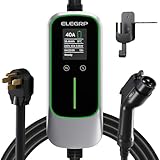
- Fast & Adjustable Charging: Up to 9.6 kW (37 mph), 7x faster than Level 1, with 5 current levels (16/20/24/32/40A) to match home capacity, plus 1–12H timing delay for off-peak charging, reducing costs and easing range anxiety
- Plug & Extended Reach: NEMA 14-50 plug fits 240V outlets for true plug-and-play use, while the 25FT cable offers flexible reach across garages and driveways, eliminating the need to reposition vehicles for easier daily charging
- ETL Certified & ELEGRP PBE Protection: Fully ETL certified, ELEGRP’s exclusive PBE technology combines full-link overheat protection with a triple-layer safety system, ensuring safer, more efficient charging. Includes a 2-year warranty
- All-Weather Indoor & Outdoor Use: IP67-rated for durability in rain, snow, and extreme temps (-21°F to 121°F), with a portable design that supports home, travel, and outdoor charging, delivering reliable performance anywhere
- Universal Compatibility: Works seamlessly with Mercedes, Chevy, Ford, Mustang Mach-E, Cadillac, Hyundai Ioniq, Kia EV6/EV9, Nissan Leaf, Chevy Bolt, Chrysler Pacifica Hybrid, and all PHEV/BEV. Tesla compatible with NACS adapter (sold separately)
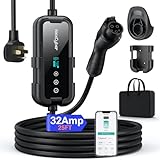
- [Up to 6X Faster Charging Speed via the NEMA 14-50 plug (32 amp)]: Provides up to 24 miles/hour charging speed via the NEMA 14-50 plug (32 amp). Professional installation recommended for optimal safety and performance. [Use the 5-15P Adapter]: 1. The RV Adapter doesn't work for EV chargers, please choose the EV adapter. 2. It will become slow level 1 ev charging and some cars may drop to 12A, the max charging rate is 1.32-1.8kW(110V*12A-120V*15A).
- [Equipped with J1772 Connector for All North America j1772 Connector EVs/PHEVs. Not fits for Tesla/Nacs Connector Cars(j1772 to Tesla adapter needed)]: Compatible with Tesla cars (Adapter needed, not included), Ford, GM, Audi, Kia, Honda, Kia, Hyundai, Gmc, Chevrolet Bolt, VW ID 4, Nissan Leaf, Ford Mustang Mach-E, IONIQ 5 2024 and before, BMW i3, i4, iX, Jeep Wrangler 4xe, etc. [Not fits for Nac connector cars-Kia EV6 2025,Ariya 2025&2025 loniq 5(J1772 to Tesla adapter needed)]
- [Safety & Faster Charging with ETL, FCC Certified]: Meets the Safety Criteria Defined by: SAE J1772, UL2231-1/-2, UL 991, UL 2231, UL 2251, UL1998 and UL 2594. (ETL and FCC certified EV car charger with 3-year Warranty)
- [Plug-play Mode(The Default Setting), Smart Touch Screen, No APP Needed]: Clearly show the charging amperage, charging speed, input voltage, delay time, etc. For the touch buttons: 1. Pull out the charging gun before press the buttons, otherwise no respond; 2. Long press "Ⓐ" or "Time" button to enter the setting interface, then you can adjust the amperage from 16A to 32A freely or Set the charging start time; 3. You can do "factory reset" if doesn't charging.
- [Smart WIFI APP, You can Set the Charging Period]: By APP, you can wirelessly check the charging cost, history, fully-charged notification, track the charging status, during off-peak period, etc. [Wi-Fi Reset/Factory Reset Function, Add New Device Quickly]: If you can't find your device or you have replaced a new phone, just pull out the charging latches, simultaneously long press the Ⓐ button and time adjustment button on the product screen until it shows "Factory Reset", then wait 3-5 seconds and re-start your device.


- 【Efficient Charging】VDLPOWERVP level 2/level 1 EV charger is equipped with NEMA 6-20 Plug(220V/240V), it offers 16A current and up 3.5kW output. Two charging options, low current charging can effectively reduce battery wear and prolong service life. Choosing to connect the conversion line for charging can realize a full day's commute mileage in one night.
- 【Level 1 & Level 2 EV Charger Adapter】This portable ev charger is equipped with NEMA 6-20 plug (Level 2, 240V, 16A) and NEMA 5-15 adapter (Level 1, 110V, 12A), you can connect our electric vehicle chargers to a standard household socket or a dedicated industrial socket, use it flexibly from anywhere in the garage or driveway.
- 【Intelligent Charging-Durable and Safe】The intelligent chip design of its control box can keep monitoring the charging status at any time, provides multiple safety protections such as lightning protection and leakage protection. This electric vehicle charger is made of premuim and sturdy materials and is FCC certified. EV Control box is IP65 waterproof and dustproof.
- 【Easy Charging and Indication Displays】Just connect to the outlet and the car, the ev charger can work properly. LED indicators that can tell you the status as well as indicate errors while charging your electric vehicle. It can help you get the charging station status information quickly.
- 【Portable Design】The ev charger has a 20ft charge cable, which is long enough for you to charge without getting tangled.The appropriate cord length and weight allow you to easily put it in the trunk of an electric car whether you are visiting friends or renting a vacation house.
This product presentation was made with AAWP plugin.